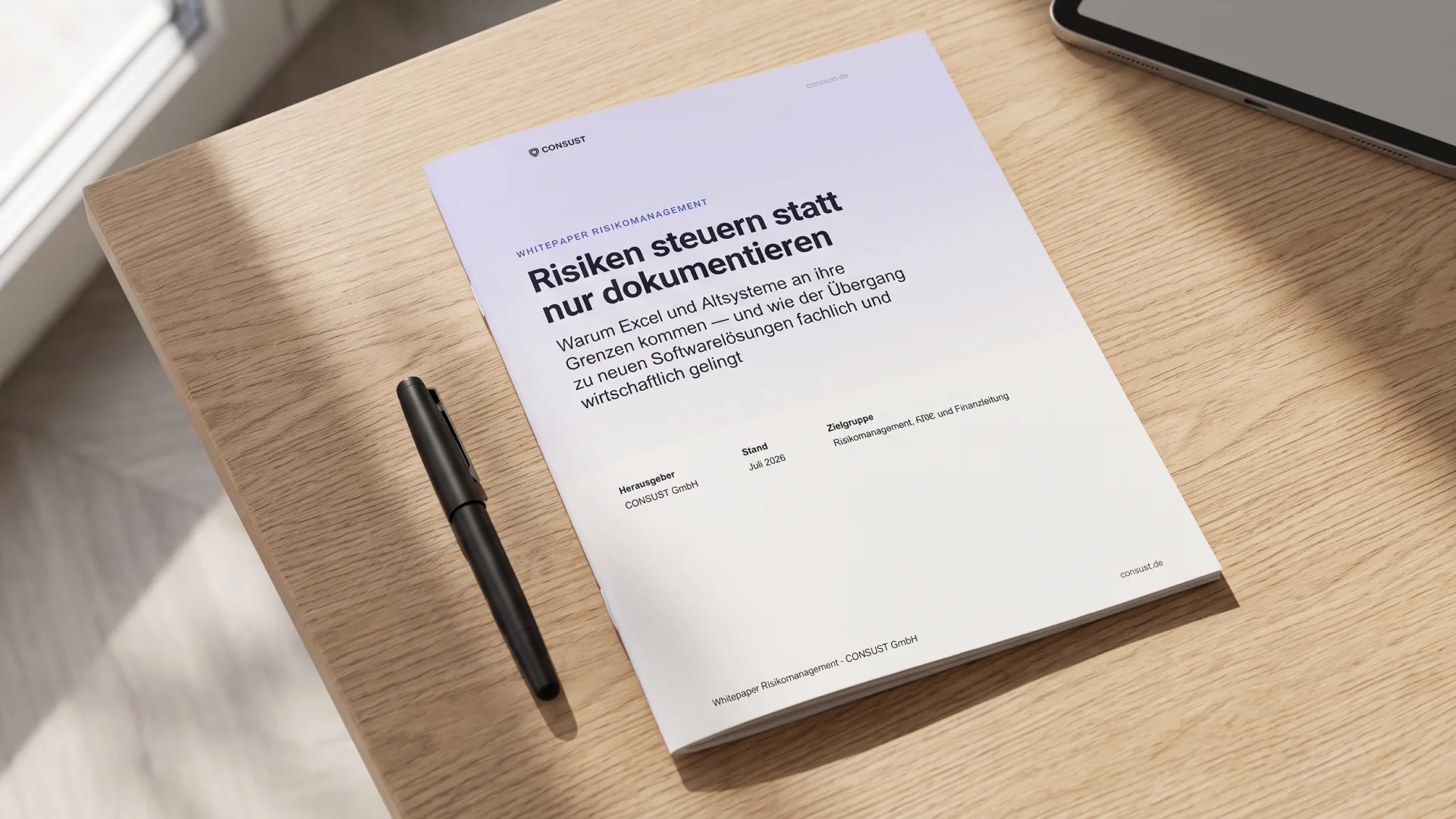
Risk Management White Paper: Replacing Excel, Managing Risks
For risk managers, GRC leaders, and finance executives who want to move beyond the annual spreadsheet cycle. This white paper highlights where Excel and legacy systems fall short in risk management and explains how the implementation of a new system can be justified from both a technical and economic perspective.
Most companies have a risk management system in place that does not actually manage anything. Risks are identified once a year in workshops, consolidated into a table, and compiled into a report for senior management. By the time this report is available, the situation has long since changed: supply chains, energy prices, cyber threats, and regulatory requirements evolve faster than the assessment cycle. The result is a body of documentation that satisfies the auditor but does not improve decision-making.
This white paper describes the technical fundamentals based on ISO 31000, identifies the specific weaknesses of table-based and outdated systems, and provides the rationale for justifying the implementation of a new system from an internal business perspective. The thesis: Risk management is not improved by putting in more effort, but rather by having a robust data foundation and a continuous process.
Here’s what you can expect in the white paper
1. Background: Risk management is a control function. Why risk management does not serve a control function in most companies, and which terms must be defined consistently across the entire organization—from gross and net risk to risk-bearing capacity.
2. ISO 31000 as a Regulatory Framework: How the principles, framework, and process differ under ISO 31000, and how the risk management process is organized into five recurring steps.
3. Where Excel and Legacy Systems Fall Short: The Five Specific Weaknesses of Spreadsheet-Based Methods—from version control to the lack of an audit trail to the lack of separation between data entry and approval.
4. Maturity Model: Five Stages Toward Manageability How companies can honestly assess their own position and define the next stage as a project goal, rather than promising to reach Stage 5 all at once.
5. The Business Case for the New System: The three benefit categories that provide the internal economic justification for the investment, including a sample calculation for a medium-sized company.
6. Procedure: The New System in Four Phases The path to the new system, from clarifying the methodology to the mandatory decommissioning date for the old table, including a cost estimate for each phase.