With CONSUST EU Taxonomy Consulting, you can efficiently navigate your way to a finished report
CONSUST EU Taxonomy Consulting empowers you to pragmatically address the challenges posed by the EU Taxonomy Regulation, given its high level of complexity and significant scope for discretion. With us by your side, you can map out the entire process—from identifying the relevant economic activities to the final EU Taxonomy Report—efficiently and with the support of software.

KEY ELEMENTS OF THE EU TAXONOMY REGULATION
The EU Taxonomy Regulation promotes sustainable business practices in relation to six environmental objectives
The EU Taxonomy Regulation establishes a clear framework for classifying “green” or “sustainable” economic activities in the EU. It defines clear rules for when an economic activity is considered sustainable, which helps such companies stand out and attract greater investment. The legislation aims to promote environmentally friendly business practices, focusing on six environmental objectives to which a total of 243 economic activities are currently assigned:

THREE KEY METRICS
The EU taxonomy focuses on three key metrics
If you are affected by the EU Taxonomy, you must demonstrate how sustainable or “green” your business activities are. To do so, you must determine and report the taxonomy-eligible and taxonomy-compliant portions for the following three key performance indicators (KPIs) through a five-step process. Our EU Taxonomy consulting service supports you in calculating all KPIs:
GREEN Revenue
The portion of net revenue generated from products or services, including intangible assets, that is related to taxonomy-compliant economic activities.
GREEN Investments
Additions to property, plant, and equipment and intangible assets during the fiscal year under review
, before depreciation and revaluations.
GREEN Operating Expenses
Direct, non-capitalized costs related to R&D, building renovations, short-term leases, maintenance, and repairs, as well as all other direct expenses
associated with the day-to-day maintenance of assets.
FIVE PROCESS STEPS
Achieve Your Goals in 5 Steps with Our EU Taxonomy Consulting
Even though the EU Taxonomy Regulation consists of a large number of individual documents and currently still allows for considerable room for interpretation, the process of complying with reporting requirements can be broken down into five clearly defined steps. Each step presents a variety of challenges that you can efficiently and pragmatically overcome with our empowering, software-supported EU Taxonomy consulting approach.
1
Identify Economic Activities
In the first step, your company’s economic activities are mapped to the economic activities defined in the EU Taxonomy Regulation based on the NACE code classification.
2
Determine Taxonomy Capability
For the identified economic activities, the corresponding revenues, investments, and operating expenses must now be calculated and recorded in a structured manner.
3
Check Technical Criteria
As part of the compliance analysis, individual criteria are used to determine whether the economic activity in question makes a significant contribution to at least one environmental objective, does not harm any other objective (DNSH), and meets the minimum social protection criteria.
4
Determine Taxonomy Compliance
The portion of revenue, investments, and operating expenses that meets the technical criteria is considered taxonomy-compliant and is calculated accordingly.
5
Create an EU Taxonomy Report
In the final step, a standardized EU taxonomy report in tabular form, including additional qualitative information, must be prepared.
Why should my company start looking into the EU taxonomy now?
Starting in 2025, all companies subject to the CSRD must comply with the EU Taxonomy Regulation
Under the EU Taxonomy, large capital market-oriented companies with more than 500 employees have been required since January 1, 2022, to disclose in their non-financial statements the proportion of their revenue, capital expenditures, and operating expenses that is environmentally sustainable. Starting in 2025, the group of companies subject to reporting requirements will expand to include those required to report on sustainability under the Corporate Sustainability Reporting Directive (CSRD).
What needs to be done now to comply with the EU Taxonomy?
Affected companies should first review their business activities for taxonomy readiness and compliance with EU taxonomy requirements. When reporting financial metrics, systems, processes, and control mechanisms must also be taken into account. Efficient reporting and ensuring the desired level of assurance require a comprehensive implementation strategy that involves all relevant stakeholders. At CONSUST, we support you with our EU Taxonomy consulting services and our FramesCube ESG platform to help you implement the new requirements with minimal effort.
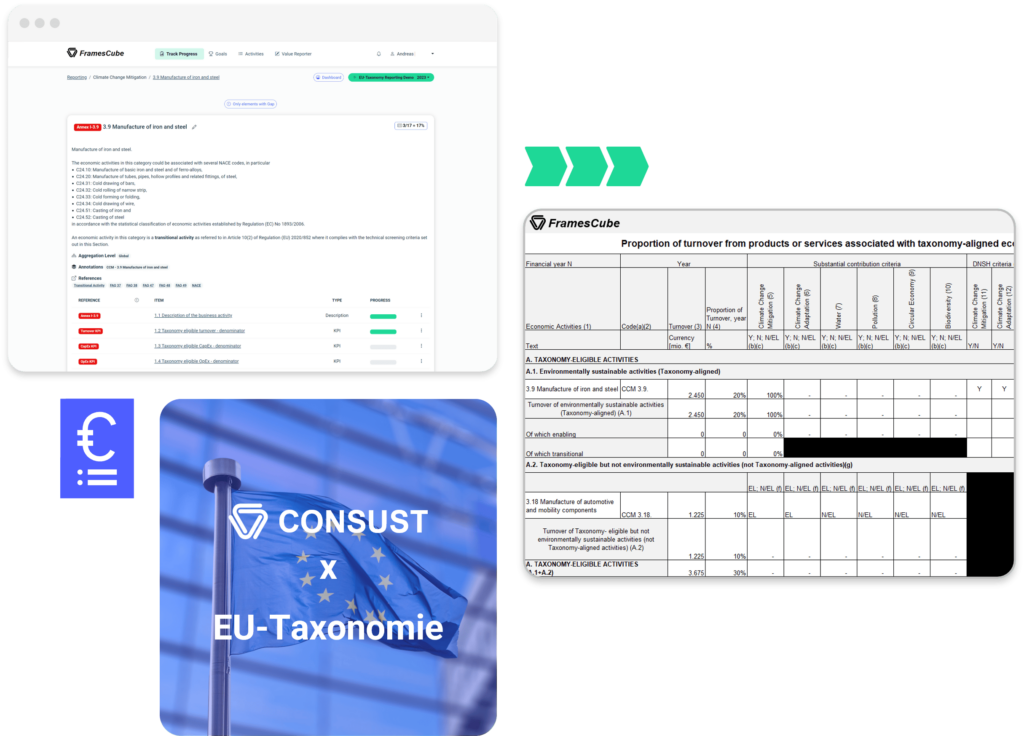
With CONSUST’s EU Taxonomy consulting and software, you’ll save time and money
CONSUST offers you EU taxonomy consulting and the associated software from a single source. Our multi-framework-compatible ESG software, CONSUST FramesCube, enables you to save up to 75% in time and costs compared to manual data entry. It automates data collection, processing, and reporting, minimizes manual tasks, and reduces human error.
Here’s how CONSUST’s EU Taxonomy consulting services guide you through the entire process
We combine profitability with sustainability.
QUESTIONS & ANSWERS