Meet EU Taxonomy and CSRD Requirements with Our Climate Risk Analysis Consulting Services
CONSUST Climate Risk Analysis Consulting enables you to conduct a robust climate risk analysis and vulnerability analysis in accordance with the CSRD and the EU Taxonomy in a cost-effective manner. To this end, we offer not only the appropriate tools and methodologies, but also the necessary climate risk data. The latter are based on the latest scientific standards and meet all regulatory requirements.

REASONS FOR CLIMATE RISK ANALYSES
Three Reasons to Conduct a Climate Risk Analysis
Proactive Management of Climate Risks
It helps you proactively identify and assess climate-related risks, such as extreme weather events or long-term climate changes, so you can plan targeted risk-mitigation measures. This allows you to significantly reduce your financial risks.
Compliance with CSRD and EU Taxonomy Requirements
A climate risk analysis is often required as part of the compliance analysis for the EU Taxonomy Regulation. In addition, under the CSRD, entities must disclose whether a climate risk analysis has been conducted.
Incorporation into Strategic Planning
Conducting a robust climate risk analysis enables proactive planning and adaptation of business strategies (e.g., selecting new locations) to better prepare for future climate-related risks.
TYPES OF CLIMATE RISKS
Analysis of Various Climate Risks for the CSRD and the EU Taxonomy


According to the EU Taxonomy , the climate risk analysis focuses on physical climate risks and on assessing whether economic activities are sustainable and contribute to climate protection without harming other environmental objectives. Transitional risks are taken into account only in a few of the DNSH criteria.

The CSRD requires a comprehensive climate risk analysis that takes into account physical and transitional risks, as well as their impact on business operations, finances, strategy, and risk management, including political, regulatory, technological, market-related, and reputational risks.
Physical Climate Risk Analysis
Physical climate risks refer to the direct impacts of climate and weather events that are changing as a result of climate change. Physical climate risks are categorized as either acute or chronic.
Acute physical risks arise from short-term, extreme weather events such as heat waves, floods, storms, droughts, or wildfires. These events can cause immediate damage to infrastructure, assets, and business operations.
Chronic physical risks refer to long-term, gradual climate changes such as rising average temperatures, sustained sea-level rise, changing precipitation patterns, or ocean acidification. These risks can have long-term impacts on the viability of locations, water availability, and agricultural yields.
Transitional Climate Risk Analysis
Transitional climate risks arise from the transition to a low-carbon economy and include changes in policy, technology, markets, and consumer behavior that contribute to mitigating climate change.
Political and regulatory risks: Changes in laws, regulations, or policy measures—such as stricter emissions regulations, carbon pricing, or subsidies for renewable energy—that may affect companies’ business operations or cost structures.
Technological risks: Risks arising from technological changes, such as the transition to clean energy or new carbon capture technologies. Companies that fail to adapt to new technologies could face competitive disadvantages or incur higher costs.
Market risks: Changes in supply and demand caused by climate change or the transition to a low-carbon economy, such as shifts in demand for fossil fuels or rising demand for climate-friendly products.
Reputational risks: Risks arising from perceptions held by the public, customers, or investors, particularly when companies are perceived as unsustainable or as harmful to the environment.
CLIMATE RISK ANALYSIS PROCESS
Achieve Your Goals in 5 Steps with Climate Risk Analysis Consulting
CONSUST Climate Risk Analysis Consulting guides you efficiently and pragmatically through all steps of the climate risk analysis in accordance with the EU Taxonomy and CSRD. We provide you with the appropriate climate risk data and related consulting services—all from a single source. Our approach strictly adheres to the requirements of the EU Taxonomy Regulation and CSRD ESRS, as well as the guidelines issued by the Federal Environment Agency.
1
Determining the Activity Lifetime
An assessment of whether the economic activity at the sites has a lifespan of more or less than 10 years.
2
Definition of Relevant System Elements
Breakdown of the locations into study objects in order to analyze the risks at the required level of detail.
3
Screening for climate-related risks
Qualitative assessment of the study subjects with regard to their exposure to climate risks and exclusion of study subjects with low or no risk exposure.
4
Conducting a Climate Risk Analysis
Detailed analysis based on external scientific climate risk data. The data provides climate risk profiles for each relevant company location.
5
Identification of Adaptation Solutions
Qualitative identification and assessment of adaptation measures in the event of high climate risk.
RELIABLE CLIMATE RISK DATA
Climate Risk Analysis Consulting Based on Reliable Climate Risk Data
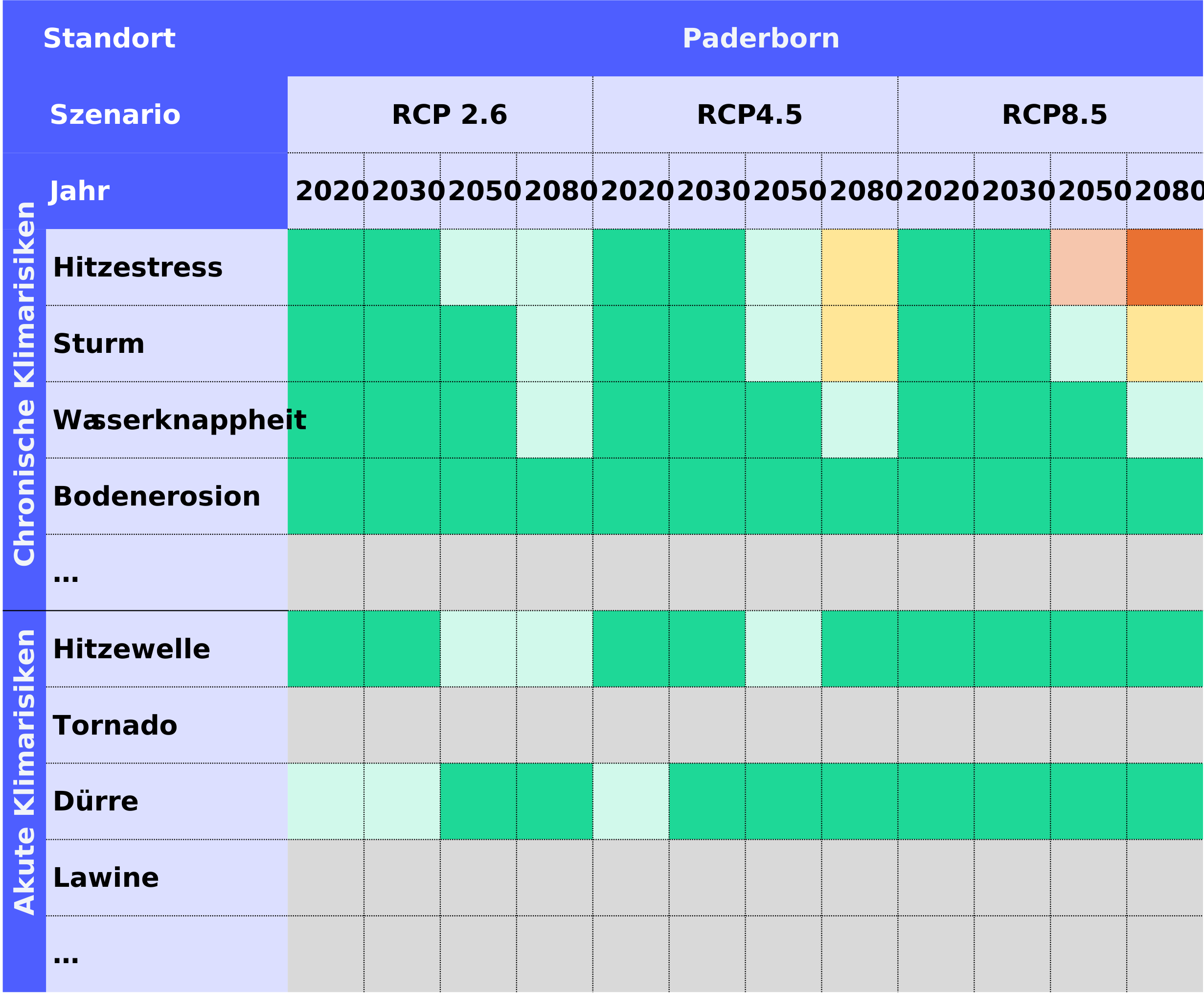
At CONSUST, our climate risk analysis consulting services are based on scientifically sound climate risk data that meets all applicable regulatory requirements under the CSRD and the EU Taxonomy:
Meet EU Taxonomy and CSRD Requirements with CONSUST Climate Risk Analysis Consulting
We combine profitability with sustainability.
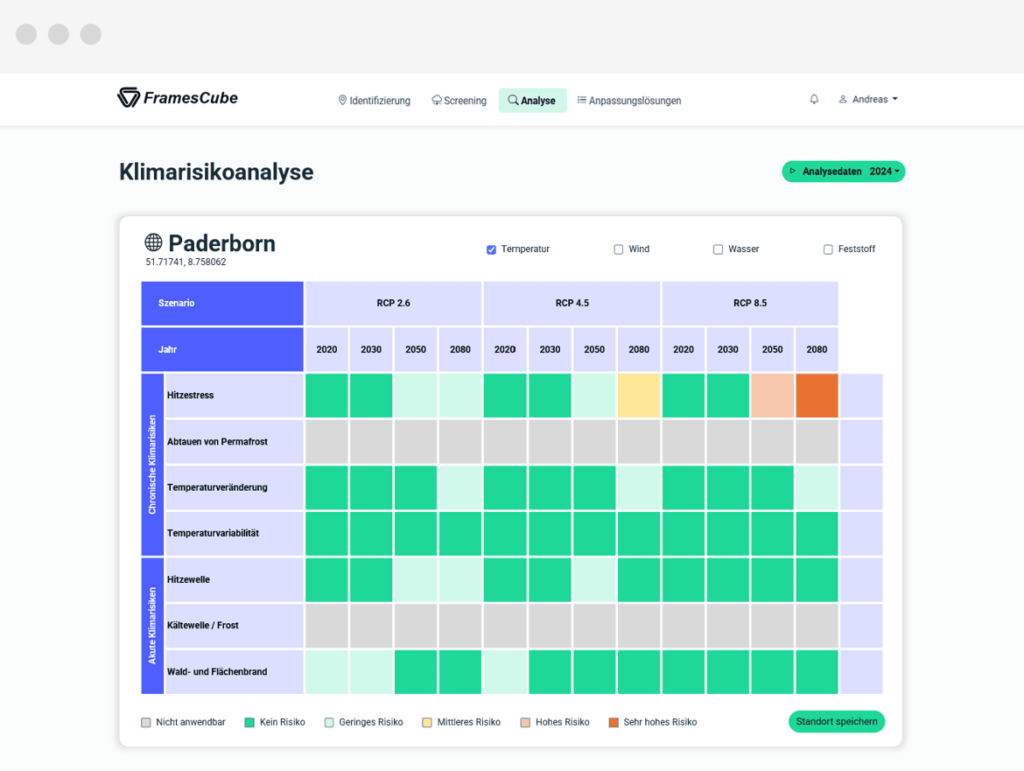
With our all-in-one ESG software, CONSUST FramesCube, you’ll save time and money
Our ESG software focuses on the CSRD, the EU Taxonomy, and the LkSG, and enables time and cost savings of up to 75% compared to manual data entry. It automates data collection, processing, and reporting, minimizes manual tasks, and reduces human error.
QUESTIONS & ANSWERS