
CDP Score Explained: How the 2026 CDP Scoring System Works
For many companies, the CDP Score is a key indicator of how robust their environmental reporting truly is. What matters is not only what is disclosed, but also how well risks, governance, targets, actions, and evidence align within the CDP framework. In this article, we explain how the 2026 CDP scoring system is structured, what role scoring categories and essential criteria play, and why strong sustainability efforts do not automatically lead to a high score.
Why the CDP Score Is So Important for Companies
CDP is no longer a niche topic. On the official Disclosure 2026 page, CDP notes that more than 23,100 organizations disclosed information during the previous cycle. At the same time, in 2026, more than 540 financial institutions with over 110 trillion U.S. dollars in assets are requesting environmental information from more than 43,000 organizations. For companies, CDP is thus a market-driven transparency tool that is relevant to investors, customers, procurement, and supply chains.
Furthermore, CDP deliberately positions its questionnaires as an interface to key standards and frameworks. On its official website, CDP highlights, among other things, strong alignments with ISSB / IFRS S2, ESRS, and TNFD; CDP also describes its broader alignment with standards and initiatives such as GRI, SBTN, and the GHG Protocol. As a result, for many companies, CDP is not merely a rating but a tool for consolidating multiple disclosure requirements into a single dataset.
What the CDP Score Measures—and What It Doesn’t Measure
One key point is often misunderstood in practice: The CDP score does not simply measure absolute environmental performance, but primarily the quality and maturity of the disclosed information. CDP explicitly states in its Help Center that scores reflect how well companies understand and manage their environmental impacts, and that the assessment is based on the levels of Disclosure, Awareness, Management, and Leadership. The score is therefore primarily an indicator of the maturity of disclosure, governance, strategy, and evidence—not merely a metric of actual environmental impact.
This has practical implications: A company may have already implemented many measures internally but still fail to achieve an optimal score on the CDP if these measures are not documented in the questionnaire in a methodologically appropriate manner. Conversely, a clearly structured, consistent response that follows the scoring logic can be rated significantly higher than a submission that is strong in content but poorly worded. This is precisely why understanding the methodology is more important than simply “filling out” the form.
Here’s how the CDP scoring works
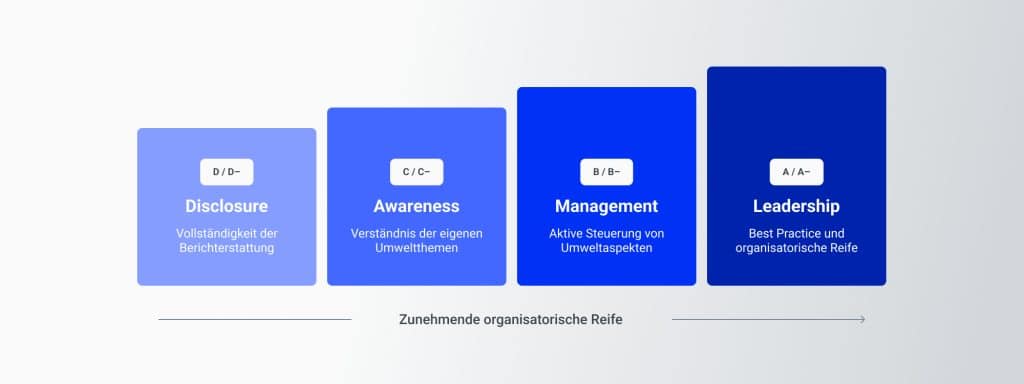
CDP evaluates responses based on four maturity levels: Disclosure, Awareness, Management, and Leadership. This results in the well-known letter-grade score ranging from D to A. This framework illustrates the path from basic disclosure to a best-practice approach.
Disclosure (D / D-)
At this level, CDP primarily assesses whether a company discloses relevant information in a complete and transparent manner. This concerns the fundamentals of reporting: Are key data points included, have the fields been filled out, and is the response generally evaluable? CDP describes this level as a measure of the completeness of reporting.
Awareness (C / C-)
Awareness refers to an understanding of one’s own environmental issues. Companies must demonstrate that they have clearly identified how environmental aspects relate to their own business model, activities, risks, impacts, and opportunities. Awareness is thus the stage at which data collection evolves into a systematic understanding.
Management (B / B-)
Management means active steering. At this level, CDP expects companies not only to understand environmental aspects but also to establish processes, responsibilities, measures, and management approaches to address them. This is precisely where the assessment shifts from description to implementation.
Leadership (A / A-)
At CDP, “Leadership” stands for best practice. At this level, companies must demonstrate that they have established ambitious strategies, robust target systems, verified data, and a mature integration of governance, progress, and environmental management. Leadership is thus less about a “good report” and more an expression of organizational maturity.
How Answers Are Turned Into a Final Score
The final CDP score is not derived from a single overall rating, but rather from a combination of scoring levels, scoring categories, and essential criteria. According to CDP, each response is evaluated using a published scoring methodology; this initially yields a result for each rating level and each topic area. The final letter grade is then derived from these results.
It’s important to note that, for Disclosure and Awareness, CDP uses a percentage ratio of points earned to possible points. At the Management and Leadership levels, categories are additionally weighted. This means that not every topic area carries the same weight. Certain areas—particularly those highly relevant to corporate governance—have a greater influence on the final score than others. CDP explicitly notes that governance and target-setting categories typically carry greater weight.
In practice, this is a crucial difference: Those who focus on operational details but only address governance, strategy, and target systems superficially often lose points precisely in the areas that have the greatest impact on the score. A good CDP score, therefore, does not result from the sum of many individual pieces of information, but rather from the proper weighting of the right information.
Scoring Categories: The Often Underestimated Core of the Score
The scoring categories are a particularly important component of the methodology. CDP describes these as thematic groupings of questions, such as those related to governance, business strategy, targets, risk disclosure, verification, environmental policies, or value chain engagement. These categories structure the assessment and are weighted in the final result, particularly at the management and leadership levels.
That is precisely what makes these categories so relevant in practice. After all, a company may be able to provide solid answers to many questions, but it can still lose ground if its answers fail to convince in areas that carry significant weight. According to CDP, categories such as governance and target-setting typically carry particular weight because they contribute significantly to the assessment of a company’s environmental management. Failure to properly address these levers often limits the overall result more than gaps in detailed operational questions do.
Another practical point: Category Scores help you interpret the results more effectively. They show in which subject areas the response is strong or weak. This makes them ideal for analysis after the scores are released—and even better for preparing for the next cycle.
Essential Criteria: The Actual Score Gatekeeper
Anyone who views CDP solely as a scoring system overlooks one of its most important mechanisms: the Essential Criteria. These are mandatory minimum requirements that must be met in order to even reach a certain score level. CDP clearly explains in its Help Center that even if a response achieves a sufficient score, it may remain at a lower rating level if relevant Essential Criteria are not met.
This is precisely one of the most common reasons why companies misjudge their own performance. Internally, a response often seems “actually strong” because there is a lot of content. Methodologically, however, the response may not be eligible for advancement because a mandatory criterion is missing. CDP therefore explicitly describes the Essential Criteria as absolute requirements designed to ensure that a certain minimum level is achieved at every evaluation stage.
One piece of information from the CDP materials is particularly valuable for practical application: Category Scores are not lowered by Essential Criteria. This means that a company may see relatively strong category scores, while the final letter grade is still significantly lower. This scenario is a very strong indication that not all relevant Essential Criteria were met. This is one of the most useful insights for analyzing the causes behind a result.
Why Good Sustainability Efforts Don’t Automatically Earn a High Score
Many projects reveal the same fallacy: If a company takes significant internal action, this should automatically be reflected in a high CDP score. However, CDP makes it clear that only the information documented in the questionnaire itself is evaluated. External links or attachments are generally not taken into account, unless the methodology explicitly provides for them.
This fundamentally changes the logic of the process. High-quality content loses value if it is described in the questionnaire only in general terms, inconsistently, or too vaguely. Conversely, responses that are clearly aligned with the methodology gain value because they provide exactly the information that CDP actually evaluates. CDP scoring is therefore less of a writing project and more of a translation project: internal sustainability efforts must be translated into the logic of the external assessment.
The Most Common Reasons for Score Declines
In its scoring materials, CDP identifies several common weaknesses that regularly cost companies points. These include, among other things, blank fields, generic wording, inconsistent data across multiple questions, missing supporting documentation, poorly explained delimitations, and failure to meet Essential Criteria.
The issue of consistency is particularly critical. CDP points out that responses must be logical not only within a single question, but across the entire questionnaire. If target horizons, responsibilities, risk statements, data points, and measures do not align, not only does credibility suffer, but so does the ability to assess the response. In practice, it is precisely these kinds of inconsistencies that often cost more points than individual missing data fields.
A second common mistake is an inappropriate level of detail. Many responses remain at the “Awareness” level in practice, even though companies could have long since provided internal management evidence. The reason is often that while measures are mentioned, they are not sufficiently described as controlled, monitored, accountable, or verified processes. It is precisely this transition that often determines whether a response remains at level C or moves up to level B.
How Companies Can Targetedly Improve Their CDP Score
1. Make the methodology the basis for our work
CDP explicitly describes the scoring methodology as a roadmap to best practices. In practice, this means that the methodology should not be used solely for verification at the end of the process, but rather to structure the entire process—from data collection to the final review cycle. Those who work in accordance with the assessment logic increase the likelihood that their response will not only be complete but also earn a high score. You can read more about scoring and the methodology in this article .
2. Assess Essential Criteria Early
Because essential criteria can limit the score even with a good point total, they should not be reviewed only shortly before submission. Companies stand to gain a great deal by identifying these criteria early on and incorporating them specifically into their work. This way, methodological gaps become apparent before they undermine the overall result.
3. Understanding Governance and Target Systems as Leverage for Scores
Especially at the higher rating levels, governance, business strategy, and targets are not secondary issues but key drivers of the score. Those who address these areas only superficially often limit their score more than they would by focusing on detailed operational questions. The category weightings described by CDP make it clear why these topics are disproportionately important.
4. Use Category Scores for Diagnosis
Category scores are not just a reporting detail, but a practical diagnostic tool. If individual categories look strong but the final score falls short, it’s almost always worth taking a closer look at the essential criteria for the relevant level. It is precisely this combination that helps you understand where score losses are occurring and address them in the next cycle.
5. Understand CDP as an assessment framework, not just a questionnaire
The greatest leverage often lies in the project logic itself. Successful responses rarely result from simply writing “good texts” at the end. Successful responses arise when data collection, responsibilities, approvals, and reviews are organized from the very beginning in accordance with the evaluation logic. Then, CDP becomes not just a deliverable, but a controllable process.
How to Categorize 2026 in Terms of Content
For 2026, public scoring will remain focused on Climate Change, Forests, and Water Security. At the same time, CDP is expanding the questionnaire to include new content, such as questions on oceans and more detailed questions on plastics, though these will not yet be scored in 2026. We have therefore deliberately compiled the content updates for this year’s cycle in a separate article.
Conclusion: A strong CDP score is the result of methodology, not just hard work
The CDP Score is neither a traditional ESG rating nor a mere point-scoring exercise. It is the result of a clear assessment framework that combines disclosure, understanding, management, and best practices. Therefore, anyone who truly wants to master CDP must not only provide content but also understand how CDP evaluates that content—through scoring levels, scoring categories, weightings, and essential criteria.
That is precisely the difference between a “fully completed” response and a high-scoring response. Companies that organize their methodology, data, governance, and review processes effectively in line with CDP’s framework not only increase their chances of achieving a better result but also create a more robust foundation for their overall environmental reporting.